Third Shot Selection in Pickleball
Learn the simple decision‑making framework 4.0 pickleball players use to choose between a third‑shot drop or drive. Improve your court awareness, avoid common 3.0–3.5 mistakes, and start winning more points with smarter shot selection.
Bob Savar, PPR-Certified Pickleball Instructor
1/20/20264 min read
Third Shot Selection: The Smart Framework 4.0 Players Use (That Most 3.0-3.5s Miss)
You're at the baseline. The serve is solid. The return comes back deep—and now it's your move.
What you do next determines if you stay stuck or take control.
For most 3.0–3.5 pickleball players, this third shot becomes a robotic decision:
“Drop it into the kitchen. Every time.”
It’s what coaches taught. It feels safe. So, they stick with it—even when it's the wrong call.
But players who reach 4.0 don’t just default to the drop. They follow a decision framework—a real-time process based on what’s happening on the other side of the net.
And that’s the difference.
In this guide, we’ll break down that framework and how you can start using it today to make smarter third-shot decisions and finally break through the plateau.
Why the Third Shot Is So Important
The third shot isn’t just the third hit. It’s the gateway to offense.
Get it right, and you earn the right to move up, take the kitchen, and control the rally.
Get it wrong, and you stay back—while your opponents take over the point.
So why do so many players play the wrong shot?
Because they turn a smart rule-of-thumb into a rigid rule.
3.0-3.5 Players vs. 4.0 Players: What They Do Differently
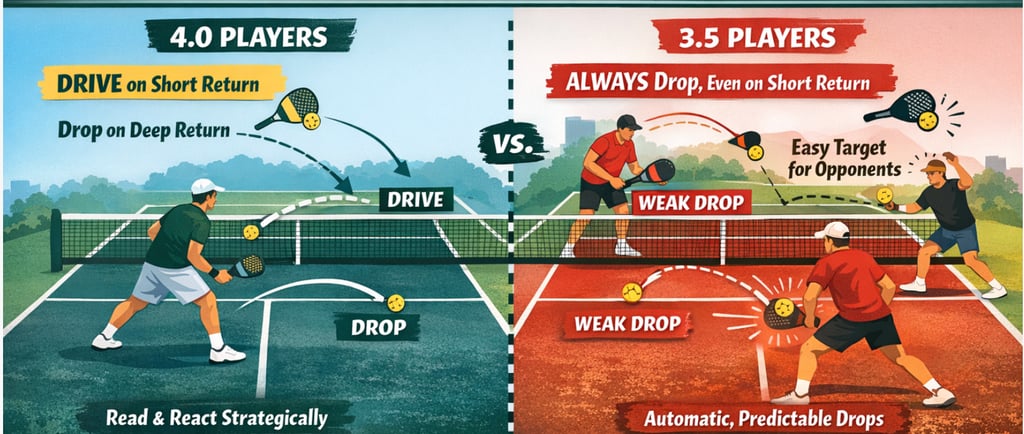
At 3.5, players often treat the third shot drop as gospel. They hit it no matter what—whether opponents are ready or not, whether the return is short or deep, or whether they’re balanced or lunging.
At 4.0, players don’t make this mistake.
They observe.
They adjust.
They decide.
Here’s the simple third shot selection framework 4.0 players use:
Drop when:
Both opponents are set at the kitchen line.
The return is deep and slow enough to give you time.
You’re balanced and in control.
Your drop is reliable in practice (80%+ success).
Drive when:
One or both opponents are still moving forward or off-balance.
The return is short, inside the baseline.
You’re off-balance or rushed—a drop would be risky.
You’re facing opponents with weak hands or slow reactions.
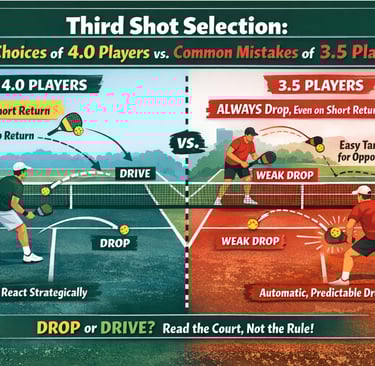
👉 Big takeaway: 4.0 players use the drop as a default, but only in the right situations. They drive with purpose when the court calls for it.
The Most Common 3.0-3.5 Mistakes
Let’s look at what’s holding most players back:
1. Auto-Dropping
Many players treat the drop as a must. They stop watching their opponents and ignore the actual court dynamics.
Problem: If your opponents are still on the move, that soft drop becomes a free ball for them to pounce on.
2. Fear of the Drive
Players avoid the drive because they’re afraid of hitting out or getting countered.
But this fear limits growth.
Drives—when used correctly—buy you time, create pressure, and open the door to attack.
How to Train This Framework
You don’t need to ditch your drop. You just need to layer in better awareness and timing.
Here’s how to start:
1. Read the Court First
Every time you hit a third shot, ask yourself:
Where are the opponents standing?
Are they set at the line? → Drop.
Are they still advancing? → Drive.
This builds the habit of scanning the court—not just staring at the ball.
2. Use the “One Step Back” Rule
A quick tip for beginners:
If your opponent is one step or more behind the kitchen line, drive it.
If they’re planted, drop.
This isn't perfect, but it trains your awareness and helps you make smarter split-second decisions.
3. Drill Drives, Not Just Drops
Most players drill their drops endlessly (which is good), but neglect drive work.
Here’s a great third shot drive drill:
Serve → return → drive low and deep at your partner’s feet.
Repeat 20–30 reps.
Mix in short returns where you drive, and deep returns where you drop.
The goal: make the drive a go-to option, not a panic move.
Bonus: Add the 2026 Hybrid Shot
In pro play, we’re seeing more hybrid third shots—a medium-pace drive with topspin.
This is a flexible middle ground between drop and drive. It gives you pressure and margin for error. Try adding it on borderline returns (e.g., mid-court balls with height).
The Results You’ll See
If you apply this framework, here’s what will start happening:
You’ll reach the net more often.
You’ll stop giving away free points on weak drops.
You’ll feel more in control of rallies.
Your game will feel smoother and less frantic.
You’ll start getting noticed as a more strategic, tougher opponent.
Most importantly, you’ll break out of the 3.5 plateau and start competing like a true 4.0.
Your First Action Step
Film one of your matches this week.
Watch just the third shots you hit.
For each one, pause and ask:
Where were my opponents?
What was the return like?
Did I drop or drive?
Was that the right choice?
This reflection will accelerate your learning more than any drill.
Want Help Getting to 4.0?
This post is just one piece of a larger journey.
If you’re ready for consistent improvement, check out my free weekly newsletter:
The Next Step to 4.0
👉 Subscribe here
You'll get:
Real lessons from Palm Beach County clinics
Specific strategies for 3.0–3.5 players
Practice tips, drills, and breakdowns
Bonus guides like “10 Mistakes That Keep 3.0–3.5 Players Stuck”
Let’s get you to 4.0—without overthinking or overplaying.
See you on the courts.
Bob Savar, PPR-Certified Pickleball Instructor
Bob Savar
Helping players break through the 3.0-3.5 plateau
ABOUT THIS SITE: This is not AI-generated content. Every breakdown, ebook, and book is written from my real coaching experience.
Contact
Connect
bob@thenextstepto4point0.com
Active coach in Palm Beach County, FL • Clinics via Meetup (2,000+ members) • Past pro interviews & community features • Publisher of Palm Beach County Pickleball News
856-275-4880
© 2025. All rights reserved.